AI Operations Layer for NetSuite: What Native AI Covers and What It Doesn't
NetSuite shipped native AI agents in 2026. Here is exactly what they cover, what still requires an operations layer on top, and how to tell the difference.
On this page
TL;DR
- NetSuite shipped real AI in 2026: named EPM agents for planning and reconciliation, AI bank-transaction matching, report narratives, and an AI Connector Service that lets you bring your own AI assistant to NetSuite data.
- All of it acts on data that is already inside NetSuite, and the named agents live on the finance side. The expensive manual work at a distributor happens before data reaches NetSuite and across systems NetSuite does not see.
- An operations layer sits on top: it reads the customer PO in your inbox, the supplier invoice, the shipping documents, and the carrier status, makes the routine decision, and writes the result into NetSuite. Only exceptions reach a person.
- NetSuite stays your system of record. No migration, no SuiteScript rebuild. Book a working session and we map your two or three highest-volume NetSuite workflows.
NetSuite Got Smarter in 2026. Your Order Desk Did Not Get Faster
If you run a distribution or manufacturing business on NetSuite, 2026 has been loud. In February, Oracle announced a set of AI capabilities at SuiteConnect: an Intelligent Close Manager, AI-powered bank transaction matching, AI-generated report narratives, and two named agents, the NetSuite EPM Planning Agent and the NetSuite EPM Reconciliation Agent. In March, at SuiteConnect London, it extended the NetSuite AI Connector Service, a standards-based integration service built on MCP that lets customers connect the AI models of their choice to NetSuite data, with a prompt library and preconfigured finance roles.
This is real progress, and if you are on NetSuite you should turn on what applies to you.
Here is what has not changed. Your customer service team still spends its mornings keying purchase orders that arrived as email attachments. Conexiom, citing APQC benchmarks, puts manual order handling at 20 to 40 percent of a customer service rep's time, with a 1 to 3 percent error rate on manual entry. Your ops team still chases shipment status across carrier portals and forwarders' emails, and still checks customs documents by eye before a container ships. None of NetSuite's 2026 AI announcements touch that work, and that is not a criticism. It is an architectural boundary worth understanding before you decide what to automate next.
What NetSuite's Native AI Actually Does Now
Credit where due. Based on Oracle's own announcements, the 2026 native AI capabilities cover:
Financial close and reconciliation. The Intelligent Close Manager monitors close activities and variances. AI bank-transaction matching classifies bank activity against the general ledger. The EPM Reconciliation Agent clears matching transactions automatically and leaves the high-risk exceptions to your team.
Planning and analysis. The EPM Planning Agent runs trend and variance analysis in natural language and explores what-if scenarios on data across the business.
Summaries and narratives. AI-generated narratives on financial and operational reports, role-based customer summaries, and AI-assisted pricing summaries that consolidate inventory, cost, and sales data.
Bring-your-own AI. The AI Connector Service lets your own AI assistant read and interact with NetSuite data under NetSuite's permissions, with a curated prompt library and MCP-ready roles such as CFO, Controller, and AP Analyst.
Notice the pattern. Every one of these works on data that is already sitting inside NetSuite, and the two named agents are finance and EPM agents. That is the right first move for Oracle: the ERP owns the ledger, so ledger-side AI belongs in the ERP.
The Work That Happens Before NetSuite Ever Sees It
At a mid-market importer or distributor, the most expensive manual work is not inside the ERP. It is the work of getting reality into the ERP and acting on what other systems know:
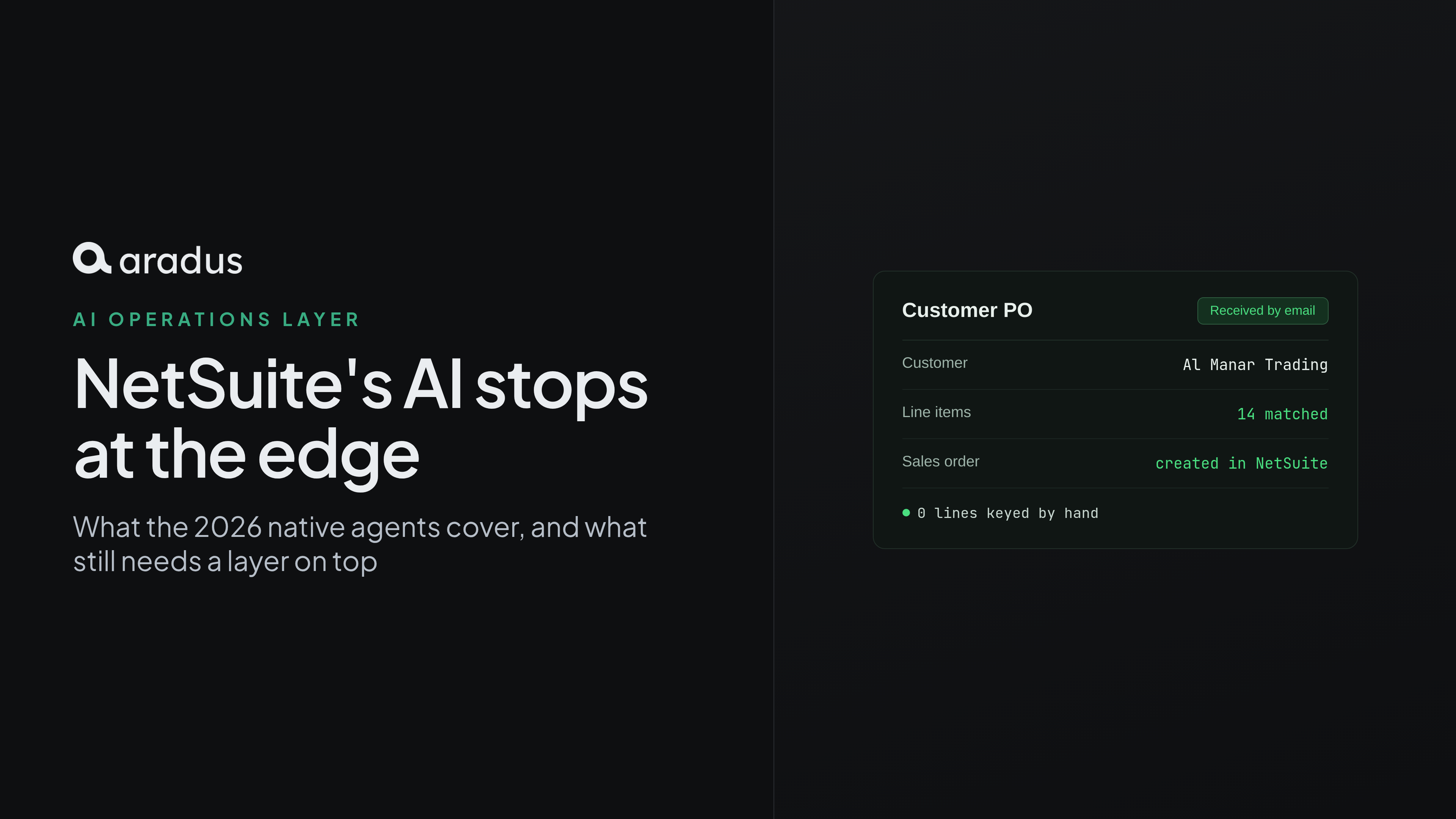
Customer POs arrive as email and PDF. Someone reads each one, matches items and prices, and keys the sales order into NetSuite. Native AI cannot summarize an order that nobody has entered yet. We covered the mechanics and the cost in our post on automated purchase orders.
Supplier invoices disagree with POs. The discrepancy lives between an emailed PDF and a NetSuite record, and versions of the invoice pile up in a mailbox thread.
Shipment documents need to be clearance-ready. Commercial invoice, packing list, certificates, bill of lading. The documents live in email and portals, the deadline lives at the port, and a gap means demurrage.
Regulations change mid-shipment. A new conformity rule or customs circular can hold a container. The signal is on a regulator's website, not in a NetSuite record.
Order and ETA status is scattered. NetSuite knows the order. The carrier, the forwarder, and the supplier know where it actually is. Someone reconciles those in a spreadsheet.
This is the operations layer's job: read the messy inputs wherever they land, make the routine decision, write the clean result into NetSuite, and route only the exceptions to a person.
This is not a NetSuite problem, and it is not a failed implementation. It is the same category gap that sits around every ERP, and we make the general argument in why manual work survives a successful ERP go-live.
How Aradus Works on Top of NetSuite
Aradus is an AI operations layer for manufacturers and distributors. It connects to NetSuite through its existing APIs, reads and writes the records NetSuite already holds, and automates the work around it:
PO and order ingestion. Incoming customer POs, from email, PDF, or portal, are extracted, matched against your catalog and price agreements, and created as sales orders in NetSuite. Mismatches are flagged to the right person with the specific reason.
Invoice flagging and versioning. Supplier invoices are checked against POs and receipts, discrepancies flagged, and every version tracked so changes are auditable instead of lost in email.
Document validation. Shipment document sets are cross-checked for gaps and inconsistencies before they cause a customs delay.
Compliance watching. Active shipments are monitored against regulatory sources, and a new rule that could hit a shipment is flagged before it becomes a hold.
Unified tracking. One live view of every order and ETA across carriers and suppliers, written back to NetSuite instead of living in a spreadsheet.
Native NetSuite AI vs. Integration Platforms vs. an Operations Layer
| Native NetSuite AI (2026) | Integration platforms (Boomi / MuleSoft / Celigo) | Aradus operations layer | |
|---|---|---|---|
| Works on | Data already in NetSuite | Data moving between systems | Messy inputs at the edges, plus NetSuite records |
| Reads an emailed PDF purchase order | No | No, moves structured data it is given | Yes, extracts, matches, creates the order |
| Named agents | Finance and EPM (planning, reconciliation) | None, you build the logic | Order, invoice, document, compliance, tracking workflows |
| Cross-system awareness | NetSuite data, plus warehouse data via connector | Yes, but you build and maintain each flow | Built in, written back to NetSuite |
| Who owns exceptions | Your team, inside NetSuite screens | Your team, plus the integration code | Routed to a named owner with the reason |
| Setup | Included, enable per module | Developer build per connection | API connection, no migration |
These are complements, not substitutes. Turn on NetSuite's native AI for close, reconciliation, and reporting. Use an integration platform if you have developers and want to own every pipe. Put an operations layer on top when the manual work you are paying for happens before and around the ERP.
What Aradus Does Not Replace
NetSuite stays the system of record. Items, customers, prices, orders, and the ledger live in NetSuite, and Aradus reads and writes through supported APIs. There is no migration and no parallel database to reconcile. Turn Aradus off and NetSuite runs exactly as before, just with your team back to keying orders and chasing documents by hand.
What Good NetSuite Automation Requires First
The same three prerequisites we hold for any ERP. Clean enough master data: if the same product carries three item numbers, automation breaks on the first mismatch, and Aradus surfaces those conflicts during onboarding. Consistent rules: automation applies one version of your pricing and approval logic, and flags everything that deviates. A named exception owner: flagged orders and documents need a person who clears the queue, or any automation degrades quietly.
Get Aradus Running on Your NetSuite Workflows
Book a working session with our team. We map your two or three highest-volume workflows around NetSuite, order intake, invoices, shipment documents, or tracking, and start where the payback is fastest.
Most mid-market environments reach a first automated workflow in weeks, not months, because Aradus connects through your ERP's existing APIs rather than a custom integration build.
Sources
- Oracle NetSuite, "NetSuite Announces AI Innovations to Help Businesses Increase Efficiency" (Feb 11, 2026): https://www.prnewswire.com/news-releases/netsuite-announces-ai-innovations-to-help-businesses-increase-efficiency-302684603.html
- Oracle NetSuite, "NetSuite Extends Commitment to Helping Businesses Use AI Their Way" (Mar 31, 2026): https://www.prnewswire.com/news-releases/netsuite-extends-commitment-to-helping-businesses-use-ai-their-way-302729229.html
- Conexiom, "The Real Cost of Manual Order Entry in B2B Operations" (Jul 2025, citing APQC): https://conexiom.com/blog/the-real-cost-of-manual-order-entry-in-b2b-operations
- Aradus, "Automated Purchase Orders: How to Eliminate Manual PO Creation": https://www.aradus.ai/blog/automated-purchase-orders-eliminate-manual-po-creation
- Aradus, "Your ERP Did Not Fail. It Was Never Going to Do This.": https://www.aradus.ai/blog/why-erp-doesnt-eliminate-manual-work