The Container Moved. Nobody Told the Order.
Shipment tracking is sold to enterprise shippers and to freight forwarders. Mid-market importers need something else: tracking attached to the purchase order, the supplier bill and the customer who is waiting.
On this page
TL;DR
- A customer asks where their order is. Answering it means a carrier site, a forwarder's inbox and a spreadsheet, because no single system holds the order and the shipment together.
- On 14 July 2026, project44 split itself into two companies: one for enterprise shippers, one for logistics providers. A mid-market importer is neither, and under that structure gets its shipment status from its forwarder's portal.
- Every agent in project44's April release for shippers works inside the freight lane. None of them knows which purchase order the container belongs to, which supplier bill is waiting on it, or which document is the reason it stopped.
- aradus tracks shipments where they are already connected to the order, the bill and the customer, on the ERP you already run. That part is live and running with customers today.
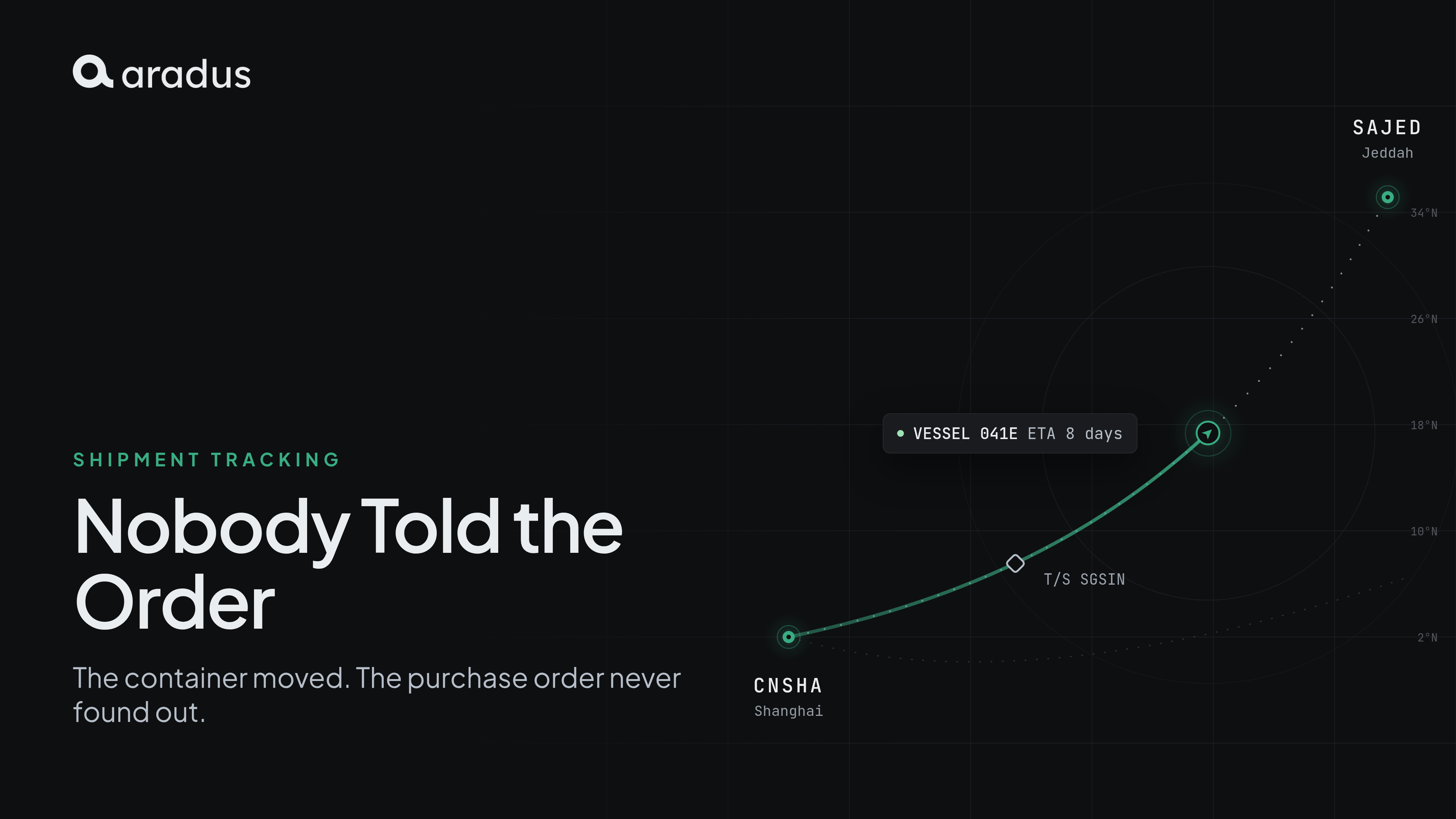
- Tracking is not a map. It is an answer to a question somebody in your business is being asked right now.
The question nobody can answer in one place
Somebody emails to ask where their order is.
To answer, a person on your team opens the carrier's site and pastes in a container number. The site has not been redesigned in a decade and shows a vessel, a port and a date that may or may not still be true. Then they open the forwarder's last email, which is three days old and came as a PDF. Then they open the spreadsheet somebody maintains, the one with the reference numbers that do not match the carrier's, because your PO number and the booking reference were never the same string. Then they write a careful reply that hedges.
Then the next email arrives, about a different order.
Nobody thinks of this as a systems problem. It reads as a person being diligent. But the diligence is doing the work of an integration that does not exist, and it happens once per question, forever.
What shipment tracking actually means for a mid-market importer
Tracking, for a company that buys goods rather than moves them, is not a dot on a map. It is the ability to answer a specific question about a specific commitment: this order, this customer, this promised date, is it at risk, and if it is, who needs to know and when.
That definition matters because it excludes almost everything sold as tracking software.
This is for importers, distributors and manufacturers who own the cargo, typically 50 to 500 people, running a lighter ERP, with more trade lanes than people to watch them. It is not for freight forwarders, carriers or 3PLs, who sell the movement and already have systems built for it. And it is not for enterprises with a logistics department and an internal engineering team, who will buy a network and integrate it themselves.
The category just told you who it is for
This used to be an inference. As of last month it is a stated fact.
On 14 July 2026, project44 announced it was separating into two businesses: project44, "the Decision Intelligence Platform for enterprise shippers," and LSP44, infrastructure for "the 3PLs, freight forwarders, and brokers who move the world's freight." Founder and CEO Jett McCandless put the reasoning plainly: "Shippers and LSPs don't buy the same thing, so we stopped pretending one business could serve both." The release states that project44 "is now purpose-built for shippers," meaning the thousand-plus enterprise brands on the platform.
Read the two boxes, then look for yourself in them. A mid-market Gulf distributor importing on TT terms is not one of a thousand enterprise brands with a logistics function. It is also not a freight forwarder. It is the party whose money is in the container.
Under the new structure, that company appears in exactly one place. LSP44's visibility agent is described as delivering track-and-trace "to LSP end customers." You are the end customer. Your shipment status is a feature your forwarder buys, presented in your forwarder's portal, refreshed when your forwarder's system refreshes it. That can be perfectly good service. It is not the same thing as your own business knowing where its orders are, and it is the reason your team still keeps the spreadsheet.
This is the same gap that shows up everywhere else in the back office: the ERP was never built to hold the state of goods in transit, so a person holds it instead.
Where the shipment record starts
A shipment is not born at the port. It is born when somebody books it.
Part of why tracking is hard for mid-market importers is that the booking usually happens outside any system: an email to five forwarders, a set of quotes in different formats, a decision, a confirmation. Whatever identity the shipment gets, it gets at that moment, and if it is created in an inbox then the tracking record starts life disconnected from the order it belongs to. Which is why we start at the quote and carry the identity through the booking rather than picking the shipment up later and trying to work out what it was for.
Tracking is only an answer if it is attached to an order
All of that assumes the order exists as a clean record in the first place.
It frequently does not. If the purchase order arrived as a PDF and somebody keyed it in, then the thing your tracking is supposed to be attached to was typed by hand under time pressure, and the quantities, part numbers and dates carry whatever that person carried. This is why order entry is the first thing to fix and not the second. Tracking attached to a wrong order produces confident answers that are wrong, which is worse than no answer at all.
What the freight agents do not know
In April 2026, project44 released a portfolio of AI agents covering, in its words, "the most consequential jobs facing shipper operations teams." The six are freight procurement, disruption management, network operations, exceptions management, slot booking and carrier onboarding. They are serious products built on a genuinely large carrier network, and project44 publishes its own results from them.
Look at the list again as a set. Every one of those six jobs lives inside the freight lane. Procuring the move, monitoring the move, fixing the move, scheduling the move, connecting the carriers who make the move.
Here is what none of them holds.
Which purchase order this container is. The commercial commitment the shipment exists to satisfy.
Which supplier bill is waiting on it. The payment that comes due whether or not the goods arrived, and whether or not what arrived matches what was invoiced.
Which customer promise it is carrying. The person who will email you, and the date you gave them.
Which document is the reason it stopped. Because a container that is not moving is usually not a transport problem.
That is not a criticism of the products. It is a description of where the boundary of the freight lane sits. Our position is on the other side of it. aradus sits on the ERP and the inbox, where the order, the bill and the documents already live, and attaches the shipment to them.
Late is not the only exception
The most expensive shipment exceptions are not transport events at all.
A container sits at the port because a classification code on the supplier invoice does not match your last three shipments and the entry drew a query. A pickup never gets booked because the free window expired while the file was incomplete. A certificate arrived as a photograph of a printout and nobody noticed a detail on it was wrong.
These are document and compliance events that present as delays. Which is why tracking has to watch the file and not only the vessel, why a rule change is something you should see as a held container rather than as a newsletter, and why an error that costs almost nothing to fix at the desk costs a great deal once the goods are at the border.
Where the tracking data comes from
Two ways, and you pick based on what you already have.
We integrate with the carriers ourselves. If you have no tracking source today, that is the normal starting point. aradus connects to the carriers and terminals directly, pulls the milestones, and attaches them to the right order. You do not buy a visibility subscription first and then find something to plug it into.
Or you bring your own. If you already have a source you trust, a forwarder feed, a TMS, a portal, a visibility network you are already paying for, aradus reads it rather than duplicating it. The tracking data stays where it is and we attach it to the order, the supplier bill and the customer promise.
The distinction is worth being clear about, because it is where most of this category asks you to choose. The value we add is not owning another copy of the milestone. It is that the milestone lands on the commitment it belongs to. Whether the milestone arrives through our integration or yours does not change that, and it means adopting this does not require ripping out something that already works.
What tracking cannot see
An honest boundary, because this is where most tracking claims quietly overstate.
If the carrier has published a milestone, we have it. If the terminal has published a status, we have it. If the forwarder has sent a document, we have read it and attached it to the shipment. Everything that has been published anywhere gets picked up, and the answer sits on the order without anyone opening a tab.
But when nothing has been published, no tracking system on earth knows. The vessel arrived and the terminal has not updated. The original bill of lading is somewhere and the forwarder has not replied. That gap is not a data problem. It is a person who has not been asked yet, and it closes with a phone call rather than another dashboard. aradus flags the silence rather than showing you a stale status and letting you believe it.
How this compares to what you have now
| Approach | Who it is built for | What the tracking is attached to | What happens when the box stops |
|---|---|---|---|
| ERP alone | Your finance and inventory records | The order, but only before and after transit | Nothing. The ERP finds out at goods receipt |
| Visibility networks (project44, FourKites) | Enterprise shippers, and logistics providers | The shipment and the carrier network | An exception is raised in the freight lane |
| Trade compliance suites (SAP GTS, MIC, e2open) | Multinationals with a compliance department | Classification, duty and screening | The filing is assessed, not the delivery promise |
| Your forwarder's portal | The forwarder, for its customers | The bookings that forwarder handles | You are told, eventually, per forwarder |
| aradus | Mid-market importers, distributors and manufacturers who own the cargo | The order, the supplier bill, the documents and the customer | One decision is raised, on the order, with the next action drafted |
What aradus does not replace
aradus is not a TMS, not a WMS and not a carrier network. It does not move your freight, manage your yard or replace your forwarder. It does not replace your ERP either. It sits on top of the one you already have.
We do connect to carriers, and we will happily be your tracking source if you do not have one. What we are not doing is competing on network breadth with the people who have spent a decade and a great deal of money building one. If you already pay for that breadth, keep it and point it at us.
What we own is the answer: the shipment attached to the commitment, so the question can be answered once instead of researched every time.
What has to be true first
Three things, and all of them are unglamorous.
Orders in a system. Not in a mailbox. If the order is not a record, nothing can be attached to it.
One shipment identity. A single reference that ties the purchase order, the booking, the container and the documents together. Most of the pain in mid-market tracking is really the absence of this.
A named person for exceptions. Automation raises the decision. Somebody still has to make it. If nobody owns that, the queue has only moved.
Shipment tracking is one of the workflows aradus runs with customers today, alongside inquiry routing, supplier bill flagging and freight procurement. It is usually where companies start, because it is the question being asked most often and the one costing the most attention.
Close
If your team answers "where is my order" by opening three tabs, that is a systems gap wearing the costume of a diligent employee.
Book a working session and we will map what your shipment record would have to look like for that question to answer itself.
Common questions
What does shipment visibility mean for a mid-market importer?
The ability to answer a question about a specific commitment, not a map of dots. Which order, which customer, which promised date, is it at risk, and who needs to be told. That requires the shipment to be connected to the purchase order, which is what separates it from plain carrier tracking.
How is this different from project44 or FourKites?
Those are visibility networks aggregating carrier data at very large scale. As of its July 2026 restructure, project44 is explicitly built for enterprise shippers, and its sister business for logistics providers. aradus is built for the company that owns the cargo, and attaches shipment status to the order, the supplier bill and the documents on the ERP that company already runs. We do not compete on network coverage.
Can I track shipments against purchase orders in my ERP?
Most mid-market ERPs hold the order before transit and the receipt after it, but not the state of the goods in between, and they cannot read a forwarder's PDF or a carrier's portal. That gap is what a person fills by hand today.
Where does the tracking data come from?
Either source works. aradus integrates with carriers and terminals directly, so we can be your tracking source if you do not have one today. If you already have a source you trust, a forwarder feed, a TMS, a portal or a visibility network you already pay for, aradus reads that instead of duplicating it. Adopting this does not mean replacing something that already works.
Do I need to replace my forwarder or buy a TMS?
No. aradus is not a TMS or a carrier network and does not change who moves your freight. It attaches shipment status to your orders, whether that status comes through our carrier integrations or through a feed you already have.
What happens when the carrier has not published an update?
No tracking system knows. aradus flags the silence rather than showing a stale status, and closing that gap is a phone call to the carrier or forwarder rather than another dashboard.
Which ERPs does this work with?
The lighter mid-market stack, including Odoo, Zoho, NetSuite, Microsoft Dynamics and SAP Business One. aradus reads the inbox as well as the ERP, so coverage is not gated on having a modern API.
Sources
- project44, project44 creates two businesses and launches LSP44, 14 July 2026.
- project44, project44 launches AI agent portfolio at decision44, 8 April 2026.