The Calls Nobody Makes
Chasing suppliers, carriers and brokers for a date, a document, or a correction is real work that mostly does not happen. Why the hard part is not dialling.
On this page
TL;DR
- The follow-up call is the most skipped task in a trade operation. Not because it is hard, but because it is expensive in attention and nobody owns it.
- Three calls carry most of the damage: where is the shipment, where is the document, and this document is wrong, please reissue it.
- Email is where follow-up goes to die. A supplier who has not answered two emails is not going to answer the third. A carrier's documentation desk will not answer at all.
- Dialling is the easy part. An outbound call is only worth making if the caller already knows which order, which document, and what was promised last time.
- The answer has to land in your system. A recording is the same job moved one step later.
- aradus now makes those calls: suppliers, carriers, brokers and forwarders, on the orders, shipments and documents it is already tracking. Launching now.
The work that does not happen
Most operational failures do not come from a decision made badly. They come from a question nobody asked in time.
Three questions do most of the damage.
Where is it? The supplier has not confirmed the ship date. The vessel has sailed and nobody has checked whether it is still on the schedule it left on. The broker has not come back on clearance.
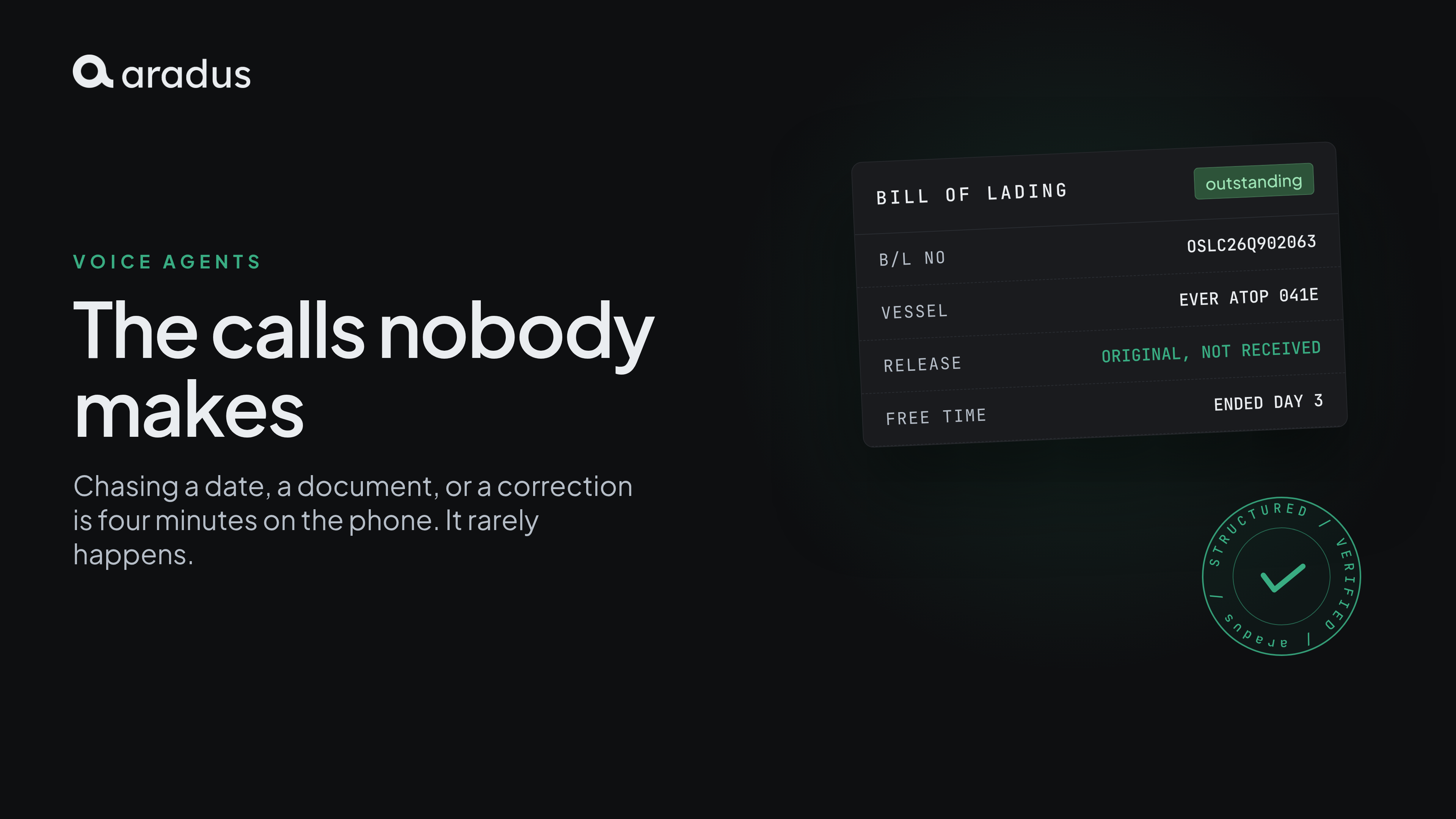
Where is the document? The original bill of lading is still sitting with the carrier and you cannot take delivery without it. The original certificate of origin never arrived, so the goods will clear at full duty instead of the preferential rate you priced the deal on. The packing list came, the invoice came, and the one piece of paper that has to exist as a physical original did not.
This one is wrong, please reissue it. A consignee name is spelled differently to the one on the letter of credit. A weight does not match. An HS code on the certificate is not the one you declared. Every correction means going back to whoever issued it, explaining what is wrong, and getting a new one, and there is a container accruing storage while that happens.
In every one of those cases somebody at the other end knows the answer or holds the paper, and the only thing standing between you and it is a phone call that takes four minutes.
The call does not get made. Not because your team is careless, but because making it properly means digging out the PO or the shipment file, working out exactly which document is missing and who issued it, remembering what was promised the last time you asked, working out whether it is a reasonable hour where they are, and then doing all of that again for the next eleven shipments. Multiply it across a week and the follow-up desk is a full-time job that nobody has been given.
So it falls back to email, which is where follow-up goes to die. You send one. You send another. A supplier who has ignored two emails is not going to answer the third, a carrier's documentation desk will not answer at all, and the silence reads as "on schedule" right up until it does not.
We wrote earlier about what to automate first in a back office, and the thing that surprised us was that order entry was not the biggest pile. Supplier chase and logistics follow-up were. That is a much less glamorous problem than reading a PDF, and it is bigger.
Why the ERP was never going to fix this
Your ERP will happily store a confirmed ship date. What it will not do is go and get one.
That is not a defect. A system of record keeps the truth it is given; it does not leave the building to find out what the truth is. We made this argument at length in why an ERP does not eliminate manual work, and supplier follow-up is the cleanest example of it. The field on the purchase order is empty, and no amount of software licensing fills that field. A person has to ask someone.
Every workflow that depends on someone outside your company telling you something has this shape. It is the reason we started with freight procurement, where the whole job is getting quotes out of forwarders and back into a comparable form. Chasing the booked shipment afterwards is the same problem one step later.
Dialling is the easy part
It is now straightforward to build software that places a call and speaks like a person. The speech layer, the turn-taking, the interruption handling: that is bought, by us and by everyone else. Nobody should sell you a phone call as though it were a breakthrough.
The two things that actually determine whether an outbound call is worth making are much less glamorous.
First, the caller has to know what to ask before it dials. "Following up on our order" is a wasted call. The useful version knows it is calling about PO 4412, that lines three and seven are still unconfirmed, that the supplier said "end of the month" eleven days ago, and that this is the second slip on this order.
The document calls need even more of it. Chasing an original bill of lading means knowing the carrier, the booking, the vessel, whether it was released as an original or a telex, and who at the documentation desk handled it. Chasing a correction means knowing exactly which field is wrong, what it should say, and which document it has to match, because the person you are calling will ask you that and a vague answer starts the round trip again.
That context does not come from the phone system. It comes from already running the operation.
Second, the answer has to land somewhere useful. Most voice tools hand you a recording and a transcript. A recording is not an answer. Somebody still has to listen to it, work out what was actually committed to, and type the date into the system. That is the job you were trying to remove, moved one step later and now with an audio file attached.
An outbound call is only automation if the new date updates the order, and everything downstream that depended on the old date gets re-checked.
How aradus does it
aradus already tracks your orders and shipments, so it already knows which ones are waiting on an answer and who owes it. That is the point of attaching tracking to the order rather than to the carrier network: the silence is visible, and the system knows exactly which commitment it is holding up. Voice is a new way for it to go and get that answer.
The chase list builds itself. Nobody writes it. It comes out of the orders and shipments that are open, past a promised date, or missing something downstream needs: an unconfirmed ship date, a document that should have arrived by now, a field that does not agree with the document next to it.
The call is scoped before it is placed. The agent goes in knowing the order or shipment, the exact thing it is calling to establish, and the history of what has already been promised. On a document call that means the specific document, its issuer, and for a correction, the exact field that is wrong and what it needs to say.
The answer is written back. A new ship date goes onto the order. A clearance status goes onto the shipment. A courier number for a posted original goes onto the document record, with the date it is expected. Whatever depended on the old answer gets flagged for a look.
You decide what needs a person, and that routes for approval. This is the part worth being precise about, because "an AI is going to call my supplier" is a reasonable thing to be nervous about.
The boundary is not ours to guess. It is yours to set. The calls that matter, and the specific rules and exceptions you mark as needing sign-off, route to a person for approval or confirmation rather than being acted on. Everything else runs.
In practice that means a routine call to confirm a ship date can go out and write the answer back on its own, while the things you have flagged as consequential wait. Agreeing to a reissue, accepting a date that breaks a commitment you have made to a customer, anything touching commercial terms: those come back to you with the context and the recommended next step already written, the same way every other exception in aradus does. Nothing consequential fires without you, and which things count as consequential is a setting, not our opinion.
Today this covers your suppliers, and the carriers, brokers and forwarders moving your goods and holding your paperwork.
Two of these connect to work we have already written about. The correction call is the expensive end of the 1-10-100 escalation: a wrong field caught at the desk is a thirty-second fix, and the same field caught after the document has been issued is a reissue, a round trip, and a container sitting somewhere on a clock. And the broker chase runs alongside the compliance watching in managing tariff changes without a compliance team: knowing a rule has changed is half of it, and the other half is a phone call to find out where a specific shipment now stands under it.
This is launching now. It is not yet running with a customer, so there are no numbers in this post, and there will not be until there are real ones.
Honest comparison
| What it does | What it costs you | |
|---|---|---|
| Email follow-up | Sends the question | Ignored at scale, no answer, silence reads as fine |
| A person on the phone | Gets the real answer | Works, and does not scale past a few dozen calls a week |
| A voice tool bolted onto your phone system | Places the call, returns a recording | Someone still listens, interprets, and types |
| aradus | Calls with the order context, writes the answer back, escalates what does not fit | Needs your orders and shipments somewhere it can read them |
What aradus does not replace
Not your relationship with your suppliers. The calls that matter commercially are still yours to make, and this exists so that your people spend their calls on those rather than on asking a factory what day it is shipping.
Not your ERP. The order still lives where it lives; aradus reads it and writes back to it.
Not a person's judgment. It gathers answers and it acts on the routine ones. Deciding what to do about a bad answer stays human work, and you set where that line falls.
What has to be true first
Your orders and shipments need to be somewhere aradus can read them, with the counterparty and a contact against them. If the promised date only exists in one person's inbox or head, nothing can chase it, because nothing else knows it is late.
And you need a view on what should happen when the answer is bad, because the value shows up in what you do with a slipped date, not in having heard about it.
Close
The gap between "we do not know" and "we know" is usually one phone call that nobody had time to make. That is a strange thing to be losing money on.
If you want to see how this would run against your own open orders, book a working session and we will walk through it on your list, not a demo one.